Research and Science outreach – Facing the crisis of trust in science
By Céline Lichtensteiger, UNIGE
Science has a major role to play in society – whether to better understand the world we live in, tackle the major challenges of our time, or help us shape the future. Quantum physics has already had a deep impact on our society, both philosophically and technologically, and is not going to stop here.
However, the current social context is questioning the knowledge established by science and the scientific method is no longer convincing people of its accuracy. We are facing a deep crisis of trust in science, with consequences that we may not be apprehending yet.
This is were science outreach comes at play. Science outreach consists of connecting the public with the scientific community, represented by institutions, research centres or researchers. And MaNEP has been an exemple in promoting science to the general public through different initiatives. To reach out to the younger generations, the Physiscope was created in 2008 by MaNEP NCCR in collaboration with the Physics Section of the University of Geneva. The Physiscope has already attracted over 88,000 visitors, including 6,300 in 2025.
Bringing together the Physiscope with the outreach activities of other scientific disciplines, the Scienscope was established in 2014, strengthening their impact, increasing their visibility, and promoting interdisciplinarity. The disciplines represented now include anthropology, astrophysics, biology, chemistry, computer science, earth and environmental sciences, mathematics, pharmacy, and physics. Bringing together these various disciplines within the Scienscope makes it possible, above all, to address certain cross-cutting and societal issues—such as sustainability—by combining the expertise of the different disciplines.
As a researcher and as the director of the Physiscope, I’m very happy to be able to contribute to Science both through research and outreach. The 2025 International Year of Quantum Physics was particularly important to me as it represented the opportunity to link directly my field of research – quantum materials – with the outreach activities conducted at the Physiscope, by creating activities on Quantum Physics for kids. Among many other things, I’ve enjoyed organising combo visits at the Physiscope and in the research labs of the Department of Quantum Matter Physics in Geneva (DQMP).
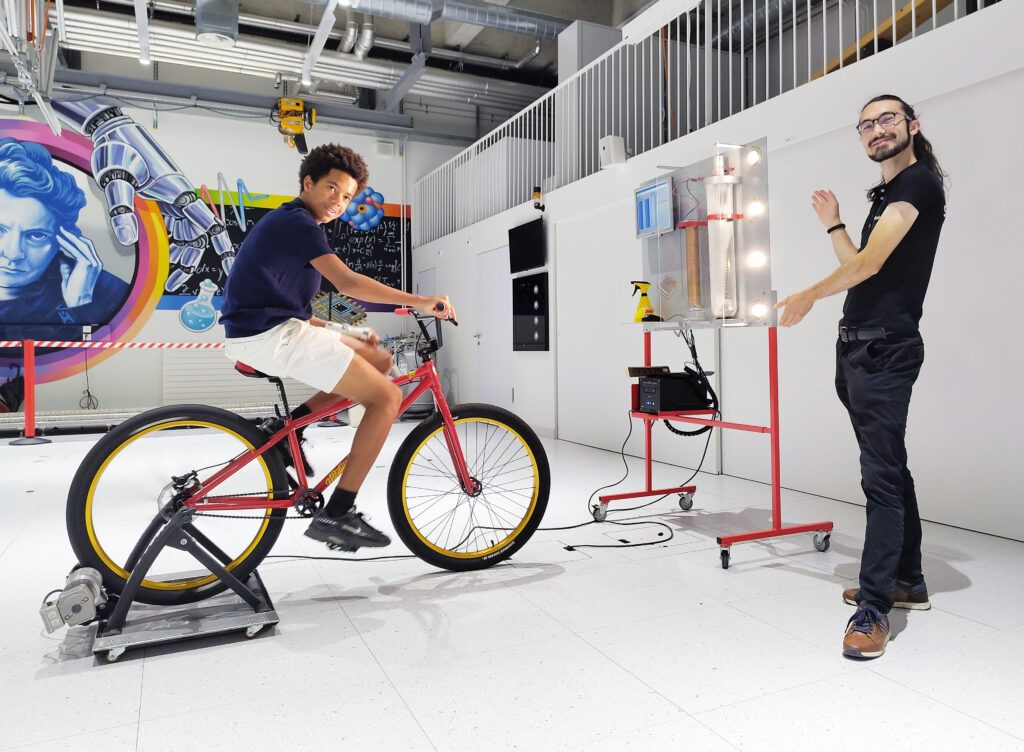
An interesting example of the link between research and outreach is with superconductivity. At the DQMP, Dr. Gianmarco Bovone in the group of Prof. Carmine Senatore is working on new superconducting wires[1], produced from billets manufactured by Maxime Domenjoz in the team of Roland Pellet from the Physics Section’s mechanical workshop. To illustrate superconductivity and perfect electrical conduction, at the Physiscope we have a bicycle with light bulbs that shine much brighter when the dynamo is connected via superconducting cables cooled in liquid nitrogen, than via copper cables. Pupils can also experiment with superconducting levitation manipulating superconducting discs that levitate above small magnets, or by sitting on a chair that levitates above a track of very powerful magnets. These experiments are entirely designed and carried out by our teams and illustrate our research work at the DQMP.
Another interesting exemple is crystal growth. In our department, we use different techniques to grow epitaxial films and single crystals of high quality, to engineer and study their new electronic properties. In a way, we play with the atoms to build new materials, like kids play with lego bricks. With my colleague Dre. Clémentine Thibault, we wanted to make atoms and crystal growth accessible to the large public and decided to create a card game – Atoberries – that presents all the atoms in a more fun way than using the periodic table of the elements. Inspired by the example of other games developed at the Physics Section (Particools by Prof. Anna Sfyrla, Tutti Quantum by Prof. Francesco Riva or |HOP> by Dr. João Ferreira), and thanks to the support of the SPS, SCNAT and FNS (Agora grant LAAR-0_241809), we are designing practical and scientifically rigorous activities, via the game and within the Physiscope, to introduce quantum concepts through the exploration of atoms. Led by female physicists – Prof. Teresa Montaruli, Dre Clémentine Thibault, Dre Alice Gasparini, and myself – this project also aims to normalise the presence of women in physics and balance gender inequality.
These are just a few examples of the many ways us researchers can – and should – reach out to the public to build and maintain trust in science. On this topic, I’ve had the honor of writing a longer paper for the Swiss Physical Society, together with Dr Michel Gauthier-Clerc, director of the Scienscope[2]. If you are interested in contributing to science outreach activities, or if you have ideas that you would like to see developed, please do not hesitate to contact me; I would be happy to discuss them with you.
With special thanks to Céline Corthay and Miguel Iglesias for their dedication to Physiscope over many years, their amazing work, technical developments and support.
[1] The final assembly consists of three OFHC copper (high-purity copper) components: a tube, a nose cone, and a plug. After machining, the tube is filled with niobium bars, and the entire assembly is vacuum-welded at CERN. Finally, the complete assembly is refined to remove weld beads and achieve a perfectly smooth surface along its entire length. The finished billet is then subjected to hot extrusion, a process capable of rapidly reducing the diameter of the billet from 70 mm to 20 mm in a single step. During this process, the billet is exposed to temperatures above 600 °C and pressures up to 1000 MPa, and precise control of every component is essential to prevent material degradation or billet fracture. After hot extrusion, a tin rod is inserted into the billet, which is subsequently drawn down to reduce its diameter. The elongated rod ultimately becomes the subunit, or subelement, of the Nb3Sn wire. A commercial Nb3Sn wire can contain more than 100 such subelements, each comprising thousands of niobium filaments that, at the end of the process, reach a diameter of just one micron. At the University, Prof. Senatore’s group is engineering Nb3Sn wires using internal oxidation, a technique that introduces special niobium alloys and oxide powders into the wire architecture to enhance both the critical current density and the upper critical field of Nb3Sn. These improvements are particularly relevant for the fabrication of high-field magnets destined for particle accelerators and high-energy physics applications.
[2] Published in the SPS newsletter, pages 51-53, link to the article