Realizing intertwined orders in a strongly interacting Fermi gas
by Jean-Philippe Brantut and Tabea Bühler, EPFL
Quantum materials often host several forms of order that interact in subtle ways: sometimes competing with each other and sometimes reinforcing one another. This interplay underlies the remarkable variety of phases found in strongly correlated systems and is key to their tunability and future applications. In our recent work, we realize a strongly correlated system with three coupled order parameters by combining an ultracold, unitary Fermi gas with photon mediated interactions [1]. The tunability of ultracold atoms coupled to that permitted by optical cavities enables us to identify and experimentally access the parameter regimes of mutual enhancement and competition of the emergent orders.
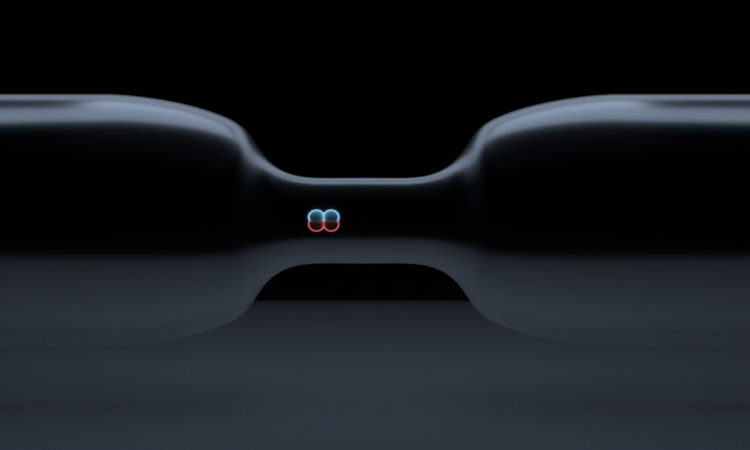
In our experiment, photons inside an optical cavity interact simultaneously and independently with individual atoms and with short-range atom pairs. The latter occurs through photoassociation, a physical-chemitry process coupling two atoms to a molecular state [2]. As a consequence, light in the cavity mediates interactions both between atoms, and atom-pairs with a tunable sign and strength. Combined with the strong correlations present in the unitary Fermi gas, this gives rise to three mutually coupled orders: the cavity photon field (X), a charge-density-wave (Θ) and a pair-density wave (Π), i.e. a spatial modulation of the short-range pairing correlations in the gas (see Fig. 1).
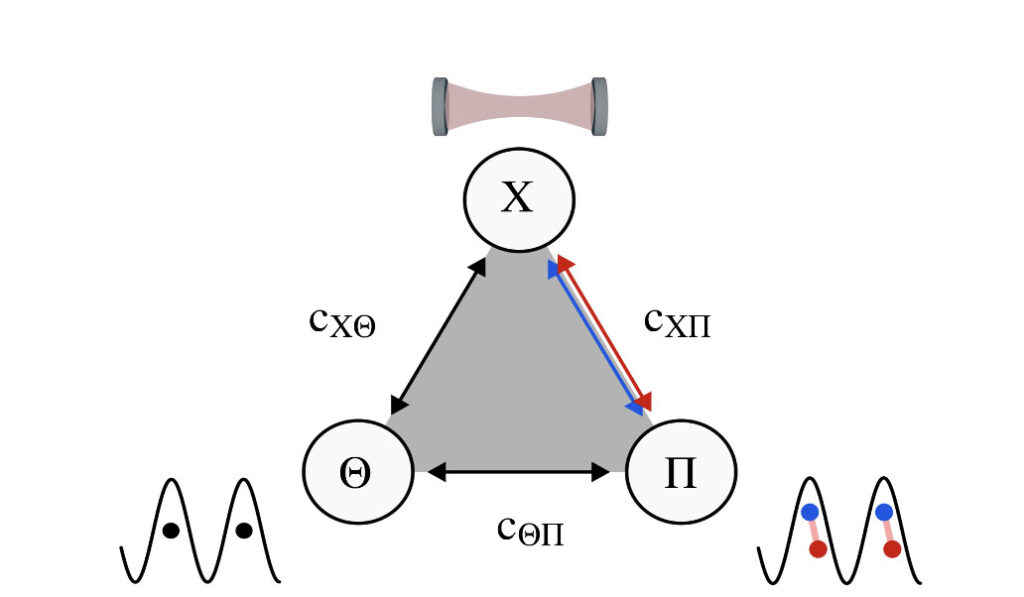
We control the coupling between atom pairs and the cavity field by changing the light frequency relative to the photoassociation transition. Then, upon increasing the cavity-mediated interaction strength, we observe the onset of a superradiant state signaling density-wave ordering in the atoms. We observe two distinct regimes: For one sign of the photon-pair coupling the ordering threshold increases with the pair coupling strength, due to frustration between competing charge and pair density-wave orders. For the opposite sign, the different orders reinforce each other, reducing the superradiant threshold.
We derive the connection between the microscopic description of our system, captured by high-order correlation functions, and a Landau free energy framework based on the coupled order parameters, allowing us to theoretically predict the phase boundary arising from their interplay. The good agreement with our experimental observations confirms our interpretation.
Our results demonstrate the potential of ultracold atoms coupled to optical cavities as a platform for exploring the interplay between different orders in strongly correlated systems. This opens new pathways towards the realization of novel phases of matter: Directly probing the nature of the pair-density wave state emerging above the ordering threshold remains an exciting challenge for future experiments.
[1]: Zwettler, T., Marijanovic, F., Bühler, T. et al. Cavity-mediated charge and pair-density waves in a unitary Fermi gas. Nat Commun 17, 496 (2026).
[2]: Konishi, H., Roux, K., Helson, V. et al. Universal pair polaritons in a strongly interacting Fermi gas. Nature 596, 509–513 (2021).
Based on article published in Nature communications