Chronicle of a discovery foretold: superconductivity in nickelates

By Dariusz J. Gawryluk and Marisa Medarde
PSI Center for Neutron and Muon Sciences, Paul Scherrer Institute
Summary
The recent discovery of superconductivity in nickel-based oxides has revitalized the research activity in this field, which faced some stagnation since the mid 2000’s due to the absence of new major experimental discoveries and theoretical progress on copper and iron-based superconducting oxides. Nickelates, sharing some structural and electronic similarities with the cuprates, have long been considered promising candidates for superconductivity. However, only in recent years has this potential been realized, with the reports of superconductivity in several Ni-based oxide families and TC values surpassing 90 K. These discoveries have uncovered several notable differences between cuprates and nickelates, especially regarding the strategies to stabilize superconductivity from the parent compounds, the required formal 3d electron count, the relative Ni 3d – O 2p band positions, and the role of electronic hybridization and magnetism. Here, we provide a survey of the rapidly developing landscape of nickelate superconductors, which is likely to bring us more exciting developments in the near future.
1. Historical context and overview of nickelate superconductors
1.1. Theoretical motivation, early efforts and main discoveries
In Gabriel García Márquez’s masterpiece, “Chronicle of a Death Foretold,” the protagonist’s death is announced in the book’s first sentence, before the story unfolds. Something similar occurred with the possibility of stabilizing superconductivity in nickel compounds, as conjectured by K.A. Müller long before the discovery of this property in cuprates. At that time, the BCS theory developed by Bardeen, Cooper and Schrieffer [1] was the state-of-the-art framework to explain the behavior of superconducting materials, most of them pure metals or intermetallics. Müller, who was working on ceramic perovskite oxides with lattice instabilities, hypothesized that the strong local electron-lattice interactions caused by the Jahn-Teller effect could provide a novel and stronger “glue” for electron pairing than the conventional electron-phonon coupling described by the BCS theory [2]. He thus focused his search on mixed-valence metallic oxides containing strong Jahn-Teller (JT) ions such as Ni3+ (3d7) and Cu2+ (3d9) in octahedral coordination known for their tendency to distort their environment, with the hope that the coexistence of conducting electrons and JT distortions could result in a sizable electron-phonon coupling. This line of research led to his and J.G. Bednorz’s breakthrough discovery in 1986 of high-temperature superconductivity in a Cu-based perovskite oxide [3], which earned them the Nobel Prize in Physics in 1987.
The quest for high-temperature superconductivity was subsequently dominated by the cuprates, characterized by the presence of layered structures with hole-doped CuO2 planes, strong electronic correlations and large exchange constants challenging conventional Bardeen–Cooper–Schrieffer (BCS) theory. Within this context, Maurice Rice and collaborators examined other materials sharing these characteristics and proposed in 1999 that superconductivity could also emerge in hole-doped nickelates with NiO2 planes and a formal cuprate-like 3d9−x electron count [4]. The prediction found little echo as monovalent (3d9) Ni is difficult to stabilize, and the scientific community was focused on unraveling the cuprates’physics. However, it was nicely confirmed 20 years after by Li and co-workers [5]. These authors reported the observation of superconductivity in thin films of the compound Nd1−xSrxNiO2 with x ≈ 0.2 – indeed an infinite stack of hole-doped NiO2 planes, a discovery that marked the beginning of the so-called “nickel age” of superconductivity.
Superconductivity has been subsequently demonstrated in other hole-doped infinite-layer nickelate thin films [6,7], and in several members of the multi-layer Ndn+1NinO2n+2 family (n = 4 to 7) [8] also grown as thin films, which feature stacks of n- NiO2 planes and cuprate-like Ni 3d fillings favorable for superconductivity even without chemical doping. Despite the common chemical environment and formal 3d electron count, superconducting cuprates and square-planar nickelates display some important differences, such as the significantly lower TC values reported for nickelates (≤ 40 K [9]) and the absence of superconductivity when they are grown in bulk form [10-12]. A notable recent development has been the possibility of increasing TC up to ≈ 74 K in freestanding Nd0.85Sr0.15NiO2 membranes by applying high pressure (≈ 90 GPa) [13], which opens novel avenues for further enhancing TC in these materials.
In parallel, pressure-induced superconductivity with TC ≈ 80 K has been observed in bulk single crystals of the Ruddlesden-Popper (RP) compound La3Ni2O7 [14-15], a somehow unexpected discovery given the non cuprate-like formal 3d7.5 electron count and the octahedral coordination of Ni in this material. This fostered further research that led to the subsequent stabilization of pressure-induced superconductivity in other RP phases [16-18], with TC values as high as ≈ 96 K [19] being reported in some such materials. Among RP compounds, La3Ni2O7 and their isostructural variants continue to capture attention and produce amazing results, such as the observation of superconductivity at ambient pressure in compressively-strained (La,Pr)3Ni2O7 thins films with TC’s up to ≈ 63 K [ 20-21].
1.2. Structural families: infinite-layer and Ruddlesden–Popper nickelates
As mentioned in the previous section nickelate superconductors are structurally diverse, primarily falling into two categories:
- Materials with square-coordinated Ni (Fig. 1a). They are layered structures with general formula Rn+1NinO2n+2 ≡ (RNiO2)n(RO2) (R = trivalent 4f cation), where n describes the number of NiO2 planes separated by RO2 fluorite-type layers (Fig. 1a). To date, superconductivity has been observed in materials with n = 4, 5, 6, 7 and ∞, with the vast majority belonging to this last infinite layer (IL) structural type. The compounds with n = 4 to 7 are naturally self-doped, with mixed Ni1+ (3d9) / Ni2+ (3d8) formal oxidation states. In contrast, Ni is formally monovalent in n = ∞ RNiO2. Although superconductivity has been reported in undoped LaNiO2, PrNiO2 and NdNiO2 [6], most IL superconducting nickelates are hole-doped with general formula R1-x AxNiO2 (A = divalent cation) and a formal cuprate-like 3d9−x electron count.
- Materials with octahedrally-coordinated Ni (Fig. 1b). They are also layered structures with general formula Rn+1NinO3n+1 ≡ (RNiO3)n(RO), known as Ruddlesden-Popper (RP) phases, where n denotes the number of corner-sharing octahedra layers separated by rock-salt-type slabs. Superconductivity has been reported for R₃Ni₂O₇ (n = 2), R₄Ni₃O₁₀ (n = 3), as well as in some RP-related phases with mixed octahedra layer stacking sequences (Fig. 1b and Table I). All these materials are self-doped with intermediate Ni2+ (3d8) / Ni3+ (3d7) formal oxidation states that depend on the number of octahedra layers and their stacking sequence.
Table I. Materials with the highest TConset reported for each superconducting nickelate structural type in the different material formats at the time of submitting this perspective.
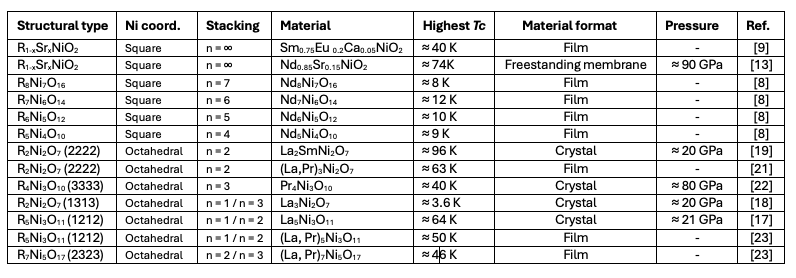
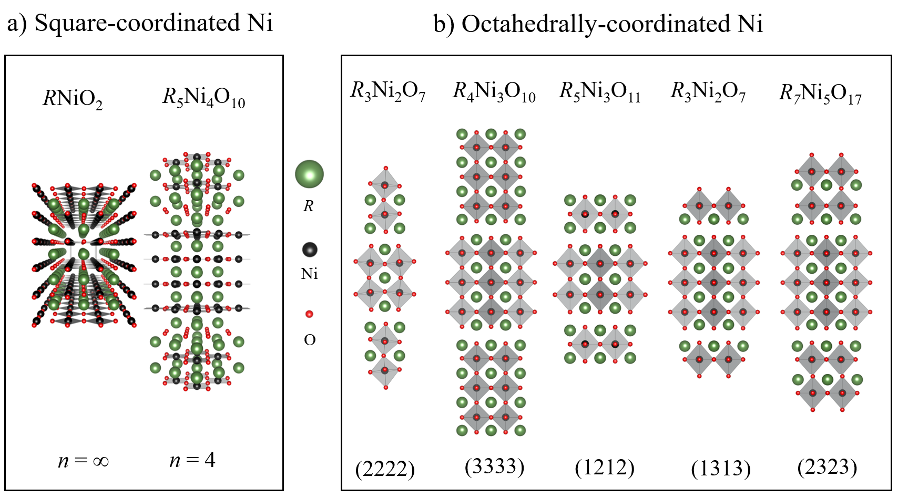
In the following we will focus on IL n = ∞ (R1-x AxNiO2) and RP n = 2 (R3 Ni2O7) nickelates, which concentrate most of the experimental and theoretical effort carried out since the discovery of superconductivity in Ni-based oxides.
2. Infinite-Layer Nickelates: synthesis, phase diagram and main properties
2.1. Synthesis and sample quality
With exception of the recently reported superconductivity in pressurized, free-standing IL Nd0.85Sr0.15NiO2 membranes [13], superconductivity has only been reported in IL nickelate thin films, while attempts to stabilize this property in bulk materials have been so far unsuccessful [10-12]. The synthesis process is challenging regardless of the material format, as the infinite-layer phase is thermodynamically unstable and can only be accessed via topotactic reduction of the RNiO₃ perovskite precursors [24-25] using reducing agents such as CaH₂, NaH or H2. This process has been applied to as-grown thin films grown using both pulsed laser deposition (PLD) [26] and molecular beam epitaxy (MBE) [27], ceramic samples [12], and also to single crystals [28]. However, the reduction process can introduce defects, disorder, and residual hydrogen, all of which impact the electronic and superconducting properties. Sample quality was a critical factor in early studies, which highlighted the importance of controlling oxygen stoichiometry, substrate-induced strain, and the elimination of extended defects to achieve intrinsic behavior. Nevertheless, sustained optimization of the growth procedure has substantially reduced these issues in the latest generation of thin films [27].
2.2. Superconducting phase diagram
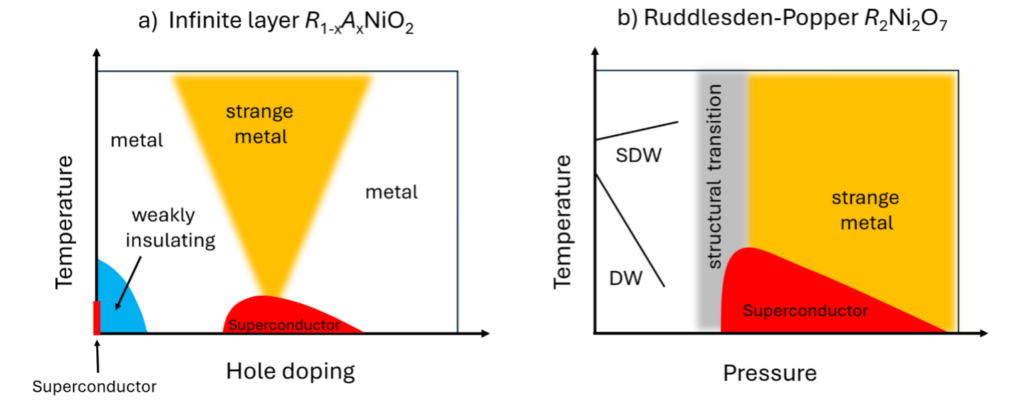
Figure 2a shows a generic, still under investigation phase diagram of infinite-layer nickelate thin films R1-xAxNiO2 at ambient pressure, where superconductivity emerges upon hole doping. The width of the superconducting dome is basically R-independent [29] and extends over formal Ni electron counts between ≈ 3d8.9 (x = 0.1) and ≈ 3d8.7 (x = 0.3) similar to that of self-doped (NdNiO2)n(NdO2) nickelates with n = 4-7 [8] and superconducting cuprates [30]. TC is generally lower in nickelates (up to ≈ 40 K [9]), but it can be enhanced under hydrostatic pressure in both, thin films [31] and free-standing membranes [13], with a huge TC increase reported in this last material format (from ≈ 20 K to ≈ 74 K under application of 90 GPa) and a linear, not-saturating TC pressure dependence. These results are particularly inspiring, opening new avenues for further TC increase and identifying high-pressure as a possible way to induce superconductivity in bulk IL nickelates.
At ambient pressure, the most recent results in high-quality thin films [32,33] reveal a fan-shaped region with resistivity ρ∝T centered at the optimal doping xc ≈ 0.15, flanked by underdoped and overdoped metallic regions with complex R(T) dependencies that include small pocket(s) featuring Fermi-liquid behavior ρ∝T2. The underdoped region is particularly complex and presently not well understood, with most studies reporting weakly insulating behavior at low temperature and superconductivity for the undoped RNiO3 parent compounds, see [6] and references therein.
2.3. Electronic structure, Fermi surface, magnetism and pairing symmetry
Although cuprate and IL nickelate parent compounds share the same formal 3d9 electronic configuration, most theoretical predictions [34-36] and X-ray spectroscopic studies [37,38] suggest that RNiO₂ fall in the Mott-Hubbard insulator regime (Fig. 3b), which contrasts with the charge-transfer insulator nature of the undoped cuprates (Fig. 3a) [30]. While the Mott-Hubbard energy U is believed to be similar in both families [35], these works reveal a larger charge-transfer energy Δ and a substantially weaker Ni 2d – O 2p hybridization in nickelates, consistent with the predicted Mott-Hubbard character (U < Δ). Hole doping supports these findings [38,39], with doped holes occupying preferentially the Ni 3d orbitals in nickelates while they have O 2p character in cuprates [30].
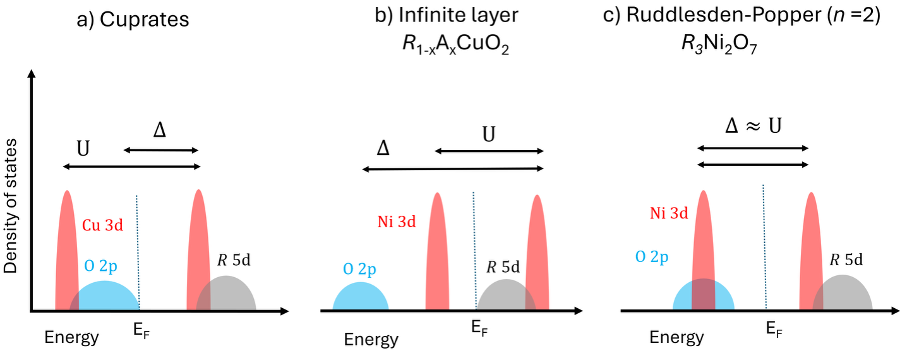
Cuprates have been largely described as charge-transfer insulators with an effective single band derived from hybridized Cu 3d – O 2p states [30]. In the case of IL nickelates, where the 3d – 2p hybridization is weaker, angle-resolved photoemission spectroscopy (ARPES) investigations suggest low-energy electronic states largely dominated by the in-plane Ni 3dx²-y²orbitals [27]. Interestingly, resonant inelastic X-ray spectroscopy (RIXS) and density functional theory (DFT) studies revealed the presence of a small hole pocket in the nickelate Fermi surface attributed to rare-earth 5d electrons that is absent in the cuprates [36-38]. The R 5d bands could thus potentially hybridize with the Ni 3d bands and self-dope the system, a question that could be relevant for rationalizing the observation of superconductivity in undoped RNiO2 [6]. It also raises the question of whether IL nickelates can be treated as effective single band systems, a topic that remains actively debated.
Unlike cuprates [30], the existence of long-range AF order has not been reported in IL layer nickelates regardless of doping and material format. In contrast, the existence of local moments and short-range magnetic correlations was inferred from muon spin rotation (μSR) measurements [40]. Moreover, RIXS experiments have revealed the existence of spin excitations whose modeling provided a first estimate of the nearest-neighbor exchange interaction (J ≈ 63 meV [41]). This value is about two times smaller than those reported for cuprates [30], in line with the less efficient Ni 3d – O 2p overlap in IL nickelates. Another important difference between both superconducting families is that the Ni 3dx²-y² Fermi surface of IL nickelates exhibits pronounced kz dispersion, indicating a more three-dimensional character than in the case of cuprates [27]. Although it is still matter of discussion, these two differences have been suggested to be connected to the lower TC values observed in infinite-layer nickelates compared to cuprates.
The superconducting gap symmetry of IL nickelate thin films is hard to investigate experimentally and remains controversial. The similarity between the CuO2 and NiO2 planes suggests that it could be also of nodal d-wave [42,43], but this question is still not settled. Additional experimental results, still very limited, should help to make progress in this direction.
3. Ruddlesden-Popper octahedral nickelates R3Ni2O7 (n = 2): synthesis, phase diagram and main properties
3.1. Synthesis and sample quality
The growth of R₃Ni₂O₇ crystals with different R-cation combinations has been achieved via optical floating zone [14] and flux [19] methods. As in the case of polycrystalline samples [15], application of O2 pressure is needed to ensure the O stoichiometry and stabilize the +2.5 formal Ni valence (50% Ni2+ + 50% Ni3+). The absence of oxygen vacancies in the apical positions connecting the two NiO2 layers is indeed believed to be particularly critical for stabilizing high-temperature superconductivity [44]. An additional synthetic difficulty comes from the tendency of RP-type compounds to form intergrowths of family members with different n [45,46] making the synthesis of RP materials with a well-defined perovskite/NaCl-type stacking sequence challenging. Recent investigations have nevertheless shown that a proper choice of the R-cation(s) [15,19], together with the use of the flux method [19], can largely inhibit the formation of RP phase intergrowths, thereby enabling the growth of 100-200 mm crystals with perfectly ordered stacking sequences, bulk superconductivity, and extremely high TC’s [15,19], well above the liquid nitrogen boiling point.
Unlike IL nickelates, pressure-induced superconductivity has been reported in both, bulk [14,15,19] and R₃Ni₂O₇ thin films [20,21]. As with single crystals, precise control of stacking faults and O stoichiometry is also a critical factor for thin films. Novel non-equilibrium thin film growth methods, such as gigantic-oxidative atomic-layer-by-layer epitaxy (GAE) [21,23], have allowed for full oxygenation and high crystalline quality, which resulted in improved superconducting properties. Moreover, the use of a substrate providing enough compressive strain enables the observation of this property at ambient pressure [20,21,23]. This is an important development that eliminates some of the limitations imposed by use of high-pressure diamond-anvil cells and should hopefully open the way to rapid advances in the experimental investigation of RP nickelates.
3.2. Superconducting phase diagram
Fig. 2b shows the generic phase diagram of bulk R3Ni2O7 (n = 2), still under investigation, where superconductivity emerges upon the application of high pressure. For R3Ni2O7 thin films, in-plane compressive strain plays a comparable (albeit not identical) role. As for IL nickelates, the R3Ni2O7 phase diagram features a slightly R-dependent superconducting dome that in this case extends between ≈ 6-15 GPa [29,47] to an (extrapolated) value of ≈ 90-100 GPa [48], with optimal TC’s up to ≈ 96 K [19] for pressures in the vicinity of ≈ 20 GPa. Another common feature is the existence of a strange metal region with ρ∝T above the superconducting dome [15], also reported for compressively strained superconducting thin films at ambient pressure [21].
A distinctive characteristic of RP n = 2 nickelate phase diagram is the existence of a pressure-induced structural transition close to the lower P-limit of the superconducting dome [49]. Although most studies converge towards a decrease and/or disappearance of the NiO6 octahedral tilts of the low-P phase by entering the high-P phase, their precise space group and the exact location of the phase boundary for the different materials is still matter of discussion [47]. The low-P region appears to be particularly complex, with several studies signaling the presence of a spin density wave (SDW) [50,51] and a second density wave (DW) of unknow origin (possibly a charge density wave) with opposite pressure dependences [52]. The phase diagram of the n = 3 compounds R4Ni3O10, while less investigated, features also intertwined SDW and DW phases at low-P, although with pressure dependencies different from those of R3Ni2O7 [53]. In both cases the superconducting phase diagrams are still under investigation.
3.3. Electronic structure, Fermi surface, magnetism and pairing symmetry
The electronic structure of normal and superconducting R3Ni2O7 RP compounds is still subject of an intense debate as these materials feature several characteristics that are absent in cuprates and IL nickelates. From the point of view of the Ni 3d electron filling R3Ni2O7 are self-doped materials, but with a formal Ni 3d7.5 electron count much lower than superconducting cuprates and IL nickelates (between 3d8.7 and 3d8.9). Moreover, the Ni-O bonds of the bilayer units appear to be equally robust within a layer than between layers. These points suggested that a proper description of the R3Ni2O7 low-energy physics would probably require the explicit consideration of two Ni 3d orbitals: dx2−y2 and dz2. Theoretical calculations [14, 54] and ARPES measurements [55,56] are consistent with this picture and confirm the involvement of the Ni 3dz2 states, which ensure the coupling within the bilayers. In contrast, spectroscopic evidence supporting Ni 3d – R 5d hybridization has remained elusive [56]. These studies also revealed a strong Ni 3d–O 2p hybridization and the presence of electronic correlations, which tentatively classify R3Ni2O7 nickelates in the intermediate regime (U ≈ Δ) of the Zaaanen-Sawatzky-Allen phase diagram (Fig. 3c).
Unlike IL nickelates, μSR and neutron diffraction experiments on R3Ni2O7 polycrystalline samples support the presence of long-range magnetic order associated with a SDW featuring high and low Ni magnetic moment stripes [51]. In contrast, the precise nature of the DW is not yet settled [52]. Interestingly, the DW transition has a clear isotope effect [54], pointing to an involvement of lattice vibrations in the formation of its associated order. In contrast, the SDW transition temperature remains unaffected within experimental uncertainty [57]. Based on the observations on cuprates [30], these results raise the question of the coexistence and / or competition of the SWD and DW orders with the superconducting state, a question that will need further investigation.
As for IL nickelates, X-ray spectroscopies on La3Ni2O7 crystals have revealed the existence of dispersive magnetic excitations [56]. Although the extracted exchange constants depend on the details of the SDW employed to model the dispersion, they point out to a pronounced out-of-plane coupling Jz, highlighting the role of the Ni 3dz2 states and the strong intra-bilayer coupling mediated by the apical oxygens. A robust Jz, seemingly specific to n = 2 RP compounds, could be connected to the large TC values reported for these materials, far above the ≈ 40 K McMillan limit for BCS superconductors and be relevant to the superconducting mechanism. Concerning the pairing symmetry, early theoretical studies suggested a dominant s-wavetype originated from interlayer coupling [54], but other possibilities have been also advanced. Experimental results, still scarce [58, 59], should help to make progress in this direction.
4.Perspective and future directions
Although the existence of superconductivity in nickelates was suspected since several decades ago, it took quite some time to bring it to light. One of the reasons is that its observation is significantly more challenging than in the case of cuprates, as it requires measurements on either thin films or highly pressurized crystals and powders. It is thus not surprising that a huge amount of research activity during the last seven years had to be devoted to the improvement of the different synthetic and analytical techniques. This was definitively worth the effort, as it enabled to grow thin films and bulk materials of much better quality in terms of O stoichiometry and crystalline perfection, a necessary condition to access the intrinsic characteristics of the superconducting behavior.
This activity, while sustained, lead to a few disruptive advancements. Perhaps the most spectacular and unexpected was the observation of superconductivity above the liquid nitrogen boiling point in pressurized R3Ni2O7 nickelates, a family where the existence of this property was never considered before due to the strong differences with the cuprates in terms of Ni coordination and the 3d electron count. A second impressive development was the fabrication of free-standing membranes of IL nickelates, which resulted in a gigantic TC increase of more than 50 K upon application of high pressure and a TC ≈ 74 K, only 3 degrees below the N2 boiling point. Equally spectacular was the stabilization of ambient pressure superconductivity in compressively strained R3Ni2O7 RP nickelate thin films with TC’s up to 64 K, to be compared with the 10-20 GPa necessary to observe superconductivity at comparable temperatures in bulk samples. This was a gigantic leap with important consequences, as it should enable the use of techniques difficult to employ under high pressure, such as X-ray spectroscopies, and to ease the use of many others.
The progress in materials synthesis has been accompanied by advances in experimental probes – in particular under high pressure-, and by huge efforts in theoretical modeling. It has also consolidated μSR and X-ray spectroscopies as essential tools for investigating the magnetism and the electronic structure of thin films. In the case of square-planar superconducting nickelates, this joint effort has resulted in some material design guidelines for creating new superconductors inspired by those employed for the cuprates [8]. For RP nickelates, the design of superconductors “a la carte” is less straightforward as it involves a new variable absent in cuprates and IL materials, which is the interlayer coupling within the multilayer perovskite blocks. Optimizing TC will probably require a tradeoff between this coupling strength and the preservation of some 2D character in the multilayer perovskite blocks, but the precise amount of each ingredient remains actively debated. Unraveling the role of other elements such as spin fluctuations, multiorbital physics and competition with spin and/or charge orders will require additional experimental efforts and theoretical modeling, as well as interdisciplinary collaboration across physics, chemistry, and materials science. This should advance our fundamental understanding of superconducting nickelates and, more broadly, unconventional superconductivity.
Acknowledgments
The authors would like to thank the great collaboration with Pascale Foury-Leylekian, Zurab Guguchia, Rustem Kasanov, and Igor Plokhikh on Ruddleson-Popper nickelates. The critical reading and feedback to this perspective by Frédéric Mila is also gratefully acknowledged.
REFERENCES
[1] J. Bardeen, L. N. Cooper, J. R. Schrieffer, Theory of superconductivity, Phys. Rev. 108, 1175 (1957).
https://journals.aps.org/pr/abstract/10.1103/PhysRev.108.1175
[2] H. Keller, A. Bussmann-Holder and K.A. Müller, Jahn-Teller Physics and high-Tc superconductivity, Materialstoday 11, 38 (2008).
https://www.sciencedirect.com/science/article/pii/S1369702108701780?via%3Dihub
[3] J.G. Bednorz and K.A. Müller, Possible high-Tc superconductivity in the Ba-La-Cu-O system, Z. Phys. B – Condensed Matter 64, 189 (1986).
https://link.springer.com/article/10.1007/BF01303701
[4] V. I. Anisimov, D. Bukhvalov and T.M Rice, Electronic structure of possible nickelate analogs to the cuprates,Phys. Rev. B 59, 7901 (1999).
https://journals.aps.org/prb/abstract/10.1103/PhysRevB.59.7901
[5] D. Li et al., Superconductivity in an infinite-layer nickelate, Nature 572, 624 (2019).
https://www.nature.com/articles/s41586-019-1496-5
[6] Y. Nomura and R. Arita, Superconductivity in infinite-layer Nickelates,Rep. Prog. Phys. 85, 052501 (2022).
https://iopscience.iop.org/article/10.1088/1361-6633/ac5a60
[7] B.Y. Wang, K. Lee and B. Goodge, Experimental Progress in Superconducting Nickelates, Ann. Rev. Condens. Matter Phys. 15, 304 (2024).
https://www.annualreviews.org/content/journals/10.1146/annurev-conmatphys-032922-093307
[8] G.A. Pan et al., Superconducting phase diagram of multi-layer square-planar nickelates, arXiv 2602.19093 (2026).
https://arxiv.org/abs/2602.19093
[9] S.L.E. Chow, Z. Luo and A. Ariando, Bulk superconductivity near 40 K in hole-doped SmNiO2 at ambient pressure, Nature 642, 58, (2025).
https://www.nature.com/articles/s41586-025-08893-4
[10] Q. Li et al., Absence of superconductivity in bulk Nd1−xSrxNiO2, Communications Materials 1, 16 (2020).
https://www.nature.com/articles/s43246-020-0018-1
[11] Ch. He et al, Synthesis and physical properties of perovskite Sm1−xSrxNiO3 (x = 0, 0.2) and infinite-layer Sm 0.8Sr0.2NiO2 nickelates, J. Phys.: Condens. Matter 33, 265701 (2021).
https://iopscience.iop.org/article/10.1088/1361-648X/abfb90
[12] H. Lin et al., Universal spin-glass behaviour in bulk LaNiO2, PrNiO2 and NdNiO2, New Journal of Physics 24, 013022 (2022).
https://iopscience.iop.org/article/10.1088/1367-2630/ac465e
[13] Y. Lee at al., High-temperature superconductivity in Nd0.85Sr0.15NiO2 membranes under pressure,arXiv 2604.09525 (2026).
https://doi.org/10.48550/arXiv.2604.09525
[14] H. Sun et al., Signatures of superconductivity near 80 K in a nickelate under high pressure,Nature 621, 493 (2023).
https://www.nature.com/articles/s41586-023-06408-7
[15] N. Wang et al., Bulk high-temperature superconductivity in pressurized tetragonal La2PrNi2O7,Nature 634, 579 (2024).
https://doi.org/10.1038/s41586-024-07996-8
[16] Y. Zhu et al., Superconductivity in pressurized trilayer La4Ni3O10−δ single crystals, Nature 631, 531 (2024).
https://www.nature.com/articles/s41586-024-07553-3
[17] M. Shi et al., Superconductivity of the hybrid Ruddlesden‒Popper La5Ni3O11 single crystals under high pressure, arXiv: 2502.01018 .
https://arxiv.org/abs/2502.01018
[18] Ch. Huang et al., Superconductivity in monolayer-trilayer phase of La3Ni2O7 under high pressure, ArXiv 2510.12250
https://doi.org/10.48550/arXiv.2510.12250
[19] F. Li et al., Bulk superconductivity up to 96 K in pressurized nickelate single crystals,Nature 649, 871 (2025).
https://doi.org/10.1038/s41586-025-09954-4
[20] E.K. Ko et al., Signatures of ambient pressure superconductivity in thin film La3Ni2O7,Nature 638, 935 (2025).
https://www.nature.com/articles/s41586-024-08525-3
[21] G. Zhou et al., Superconductivity onset above 60 K in ambient-pressure nickelate films, Nat. Sci. Rev. nwag151 (2026).https://academic.oup.com/nsr/advance-article/doi/10.1093/nsr/nwag151/8512895?login=true
[22] M. Zhang et al., Bulk superconductivity in pressurized trilayer nickelate Pr4Ni3O10single crystals, Phys. Rev. X15, 021008 (2025).
https://journals.aps.org/prx/abstract/10.1103/PhysRevX.15.021008
[23] Z. Nie et al., Superconductivity and electronic structures of nickelate thin film superstructures, Nature652, 628 (2026).
[24] M.L. Medarde, Structural, magnetic and electronic properties of RNiO3 perovskites ( R = rare earth), J. Phys.: Condens. Matter 9 1679 (1997).
https://iopscience.iop.org/article/10.1088/0953-8984/9/8/003/meta
[25] Y.M. Klein et al., RENiO3 Single Crystals (RE = Nd, Sm, Gd, Dy, Y, Ho, Er, Lu) Grown
from Molten Salts under 2000 bar of Oxygen Gas Pressure, Cryst. Growth Des. 21, 4230 (2021)
https://pubs.acs.org/doi/10.1021/acs.cgd.1c00474
[26] A. Gutierrez-Llorente et al., Toward reliable synthesis of superconducting infinite layer nickelate thin films by topochemical reduction, Adv. Sci.11, 2309092 (2024).
https://advanced.onlinelibrary.wiley.com/doi/10.1002/advs.202309092
[27] W. Sun et al., Electronic structure of superconducting infinite-layer lanthanum nickelates, Sci. Adv. 11, eadr5116 (2025)
https://www.science.org/doi/10.1126/sciadv.adr5116
[28] P. Puphal et al., Topotactic transformation of single crystals: From perovskite to infinite-layer nickelates, Sci. Adv.7, 2eabl8091 (2021).
https://www.science.org/doi/10.1126/sciadv.abl8091
[29] P. Puphal et al., et al., Superconductivity in infinite-layer and Ruddlesden–Popper nickelates, Nature Reviews Physics 8, 70 (2026).
https://www.nature.com/articles/s42254-025-00898-
[30] B. Keimer et al., From quantum matter to high-temperature superconductivity in copper oxides, Nature review 518, 179 (2015).
https://www.nature.com/articles/nature14165
[31] N.N. Wang et al., Pressure-induced monotonic enhancement of Tc to over 30 K in superconducting Pr0.82 Sr0.18 NiO2 thin films, Nature. Comm. 13, 4367 (2022).
https://www.nature.com/articles/s41467-022-32065-x
[32] K. Lee et al., Linear-in-temperature resistivity for optimally superconducting (Nd,Sr)NiO2, Nature 619, 288 (2023).
https://www.nature.com/articles/s41586-023-06129-x
[33] Y. T. Hsu et al., Transport phase diagram and anomalous metallicity in superconducting infinite-layer nickelates, Nature. Comm. 15, 9863 (2024).
https://www.nature.com/articles/s41467-022-32065-x
[34] W. Lee and W. E. Pickett, Infinite-layer LaNiO2: Ni1+ is not Cu2+. Phys. Rev. B 70,
165109 (2004).
https://journals.aps.org/prb/abstract/10.1103/PhysRevB.70.165109
[35] M. Jiang et al., Critical nature of the Ni spin state in doped NdNiO2, Phys. Rev. Lett. 124, 207004 (2020).
https://journals.aps.org/prl/abstract/10.1103/PhysRevLett.124.207004
[36] A. Botana et al., Similarities and differences between LaNiO2 and CaCuO2 and implications for superconductivity, Phys. Rev. X 10, 011024 (2020).
https://journals.aps.org/prx/abstract/10.1103/PhysRevX.10.011024
[37] M. Hepting et. al., Electronic structure of the parent compound of superconducting infinite-layer nickelates, Nature Materials 19, 381 (2020).
https://www.nature.com/articles/s41563-019-0585-z
[38] B. H. Goodge et al., Doping evolution of the Mott–Hubbard landscape in infinite-layer nickelates,PNAS 118, 2 e2007683118 (2021).
https://www.pnas.org/doi/full/10.1073/pnas.2007683118
[39] T. Plienbumrung et al., Character of Doped Holes in Nd1–x SrxNiO2, Condens. Matter 6, 33 (2021).
https://www.mdpi.com/2410-3896/6/3/33
[40] J. Fowlie et al., Intrinsic magnetism in superconducting infinite-layer nickelates, Nature Physics 18, 1043 (2022).
https://www.nature.com/articles/s41567-022-01684-y
[41] Lu, H. et al. Magnetic excitations in infinite-layer nickelates, Science 373, 213 (2021).
https://www.science.org/doi/10.1126/science.abd7726
[42] Sakakibara, H. et al. Model construction and a possibility of cupratelike pairing in a new d9 nickelate superconductor (Nd,Sr)NiO2. Phys. Rev. Lett. 125, 077003 (2020).
https://journals.aps.org/prl/abstract/10.1103/PhysRevLett.125.077003
[43] B. Cheng et al., Evidence for d-wave superconductivity of infinite-layer nickelates from low-energy electrodynamics, Nature Mat. 23, 775 (2024)
https://www.nature.com/articles/s41563-023-01766-z
[44] Z. Dong et al. Visualization of oxygen vacancies and self-doped ligand holes in La3Ni2O7 −δ. Nature 630, 847 (2024).
https://www.nature.com/articles/s41586-024-07482-1
[45] X. Chen et al., Polymorphism in the Ruddlesden−Popper Nickelate La3Ni2O7:
Discovery of a Hidden Phase with Distinctive Layer Stacking, J. Am. Chem. Soc. 146, 3640 (2024).
https://pubs.acs.org/doi/10.1021/jacs.3c14052?ref=PDF
[46] P. Puphal et al., Unconventional Crystal Structure of the High-Pressure Superconductor La3Ni2O7, Phys. Rev. Lett. 133, 146002 (2024).
https://journals.aps.org/prl/abstract/10.1103/PhysRevLett.133.146002
[47] H. Sakurai et al., Superconducting lanthanum nickel oxides with bilayered and trilayered crystal structures, J. Phys.: Condens. Matter 38 073002 (2026).
https://iopscience.iop.org/article/10.1088/1361-648X/ae4155
[48] J. Li et al., Identification of superconductivity in bilayer nickelate La3Ni2O7 under high pressure up to 100 GPa, Nat. Sci. Rev. 12, nwaf220 (2025)
https://doi.org/10.1093/nsr/nwaf220
[49] L. Wang et al., Structure Responsible for the Superconducting State in La3Ni2O7 at
High-Pressure and Low-Temperature Conditions, J. Am. Chem. Soc. 146, 7506 (2024)
https://pubs.acs.org/action/showCitFormats?doi=10.1021/jacs.3c13094&ref=pd
[50] K. Chen et al., Evidence of Spin Density Waves in La3Ni2O7 – δ, Phys. Rev. Lett. 132, 256503 (2024).
https://journals.aps.org/prl/abstract/10.1103/PhysRevLett.132.256503
[51] I. Plokhikh et al., Unraveling spin density wave order in layered nickelates La3Ni2O7 and La2PrNi2O7 via neutron diffraction, arXiv 2503.05287.
[52] R. Khasanov et al., Pressure-enhanced splitting of density wave transitions in La3Ni2O7–δ, Nature Physics, 21, 430 (2025)
https://www.nature.com/articles/s41567-024-02754-z
[53] R. Khasanov et al., Pressure and oxygen-isotope substitution on density-wave transitions in La4Ni3O10, Phys. Rev. Res. 8, 013249 (2026)
https://journals.aps.org/prresearch/abstract/10.1103/nrqn-m22c
[54] Y. Zhang et al., Structural phase transition, s±-wave pairing, and magnetic stripe order in bilayered superconductor La3Ni2O7 under pressure, Nat. Comm. 15, 2470 (2024).
https://www.nature.com/articles/s41467-024-46622-z
[55] J. Yang et al., Orbital-dependent electron correlation in double-layer nickelate La3Ni2O7, Nat. Comm. 15, 4373 (2024).
https://www.nature.com/articles/s41467-024-48701-7
[56] X. Chen et al., Electronic and magnetic excitations in La3Ni2O7, Nat. Comm. 15, 9597 (2024).
https://www.nature.com/articles/s41467-024-53863-5
[57] R. Khasanov et al., Oxygen-isotope effect on the density wave transitions in La3Ni2O7, Phys. Rev. Res. 8, L01055 (2026).
https://journals.aps.org/prresearch/abstract/10.1103/84hf-dl4p
[58] Z.Y. Cao et al., Direct Observation of d‑Wave Superconducting Gap Symmetry in Pressurized La3Ni2O7−δ Single Crystals, arXiv 2509.12606 (2026)
[59] J. Guo et al., Revealing superconducting gap in La3Ni2O7-δ by Andreev reflection spectroscopy under high pressure, Nat. Comm. 16, 10838 (2025).