Chiral Surface States in the Three-Dimensional Quantum Limit of Bismuth

by Mark Fischer and Titus Neupert, University of Zurich
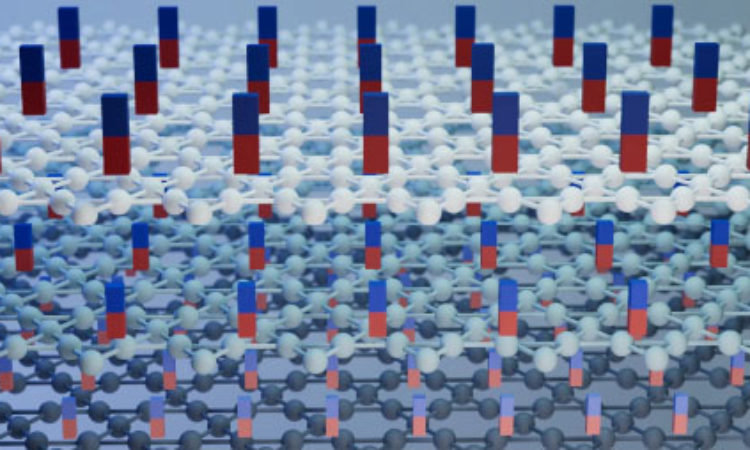
The quantum Hall effect — one of the most celebrated manifestations of topology in condensed matter physics — is characterized by dissipationless chiral edge states that arise when two-dimensional electrons are confined to Landau levels under a strong perpendicular magnetic field. Extending this physics to three dimensions has long posed a conceptual challenge: in 3D metals, electrons retain freedom to propagate along the magnetic field direction, yielding dispersive Landau bands rather than flat levels, and no strictly quantized Hall conductance. Therefore, the 3D quantum limit is fundamentally distinct from its 2D counterpart. Notwithstanding, in a collaboration between the groups of Philip Moll (MPI Hamburg) and Mark H. Fischer and Titus Neupert (University of Zurich), transport experiments in the 3D semimetal bismuth now provide direct evidence that robust chiral boundary states nevertheless emerge in this regime, carrying substantial surface currents analogous to the edge channels of the 2D quantum Hall effect.
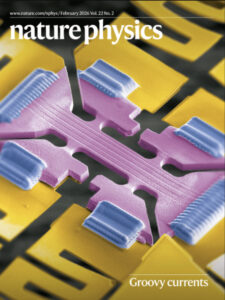
The key experimental signature relies on deliberate control over the measurement geometry: using focused-ion-beam (FIB) micropatterning to cut grooves into micrometre-sized crystalline bismuth bars, the researchers observe that conductance increases as material is removed, but only once the system is driven into the quantum limit by an applied magnetic field. At zero field, adding grooves reduces conductance proportionally to the lost cross-sectional area, as expected for conventional bulk transport. Above the quantum-limit field of approximately 2.7 T, however, each additional groove increases conductance, with the effect scaling linearly with groove depth. The angle dependence of the magnetoresistance further confirms that the enhanced conduction is tied to surfaces oriented parallel to the magnetic field — precisely where chiral boundary states are expected to reside. Tight-binding calculations of the Landau band structure of bismuth reproduce the observed surface spectral weight, confirming that the electron pockets at the L points enter the quantum limit and develop chiral surface modes, while the hole pocket at the T point does not.
A further hallmark of chiral transport — non-locality — is also demonstrated. Voltage signals detected between contacts separated by nearly 100 µm, far beyond what ohmic bulk conduction would allow, emerge specifically in the quantum limit and are enhanced by the FIB-cut grooves connecting distant electrodes. Together, these results establish chiral boundary states as an important contribution to magnetotransport in gapless 3D metals at high fields, and introduce surface-shape engineering as a new tool for controlling and exploiting chiral conduction in three-dimensional materials.
Based on article published in Nature physics