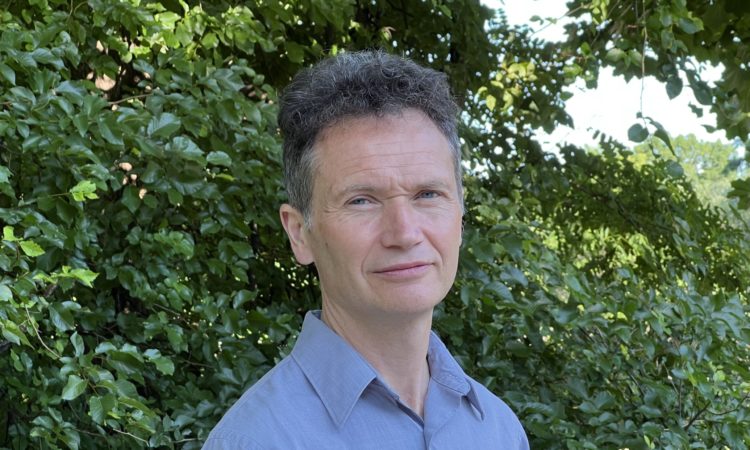
Talk with Dominik Juraschek, Professor, Unifr/PSI
Please tell us about your professional background and your main research interests?
Already during high school, I wanted to go for an academic career, even though I had no clue what that would imply. Accordingly, I studied physics and when I actually got an offer for a PhD position afterwards, I couldn’t believe it. I spent a good three years in Zurich, where my advisor fundamentally shaped me in the way I approach science until this day. I was lucky to academically grow up in a field that was just taking off: we predicted theoretically how lattice vibrations in crystals interact when strongly driven by ultrashort laser pulses. This encompassed two intertwined fields that are today known as nonlinear phononics and chiral phononics.
I was able to carry on this research throughout my postdoc in Boston and I founded the first theoretical research group explicitly focused on these topics in Tel Aviv two and a half years later. My further path led me first to Eindhoven and then to Fribourg, where I now have a joint position with the PSI. Over these years, it became clear that lattice vibrations can play a major role in fields, where they have previously been merely regarded as a waste product or heat, and instead can be used as fundamental degrees of freedom in their own right. My main research interest therefore aims to get to the bottom of how chirality and angular momentum of the crystal lattice can be harnessed for new functionalities in materials.
What is your favorite aspect of your research?
Certainly, the interactions with my group and with other colleagues. While I find it fun to dig deep into a topic by myself at times, I believe that science unfolds its true power when ideas are shared and opinions exchanged. My most impactful research has always been based on unique ideas, rather than developing new methods or computational tools, and the inspiration I receive from the input during conferences is typically where I originate most of my ideas from. Accordingly, I enjoy traveling a lot and I send my students and postdocs to as many scientific meetings as we can afford. These interactions further lead to particularly joyful moments, when our theoretical work is picked up by experimental colleagues and realized in the laboratory.
What research perspective do you see for the next 10 years?
My vision is for chiral phononics to emerge as a third foundational pillar of next-generation information technologies, on par with spintronics and orbitronics. I know that this is a bold goal, as in particular spintronics is decades ahead and has produced actual working devices, while our field is still in its infancy. This makes research even more exciting in my opinion, as we will see the confluence of these three fields in the future. Here in Switzerland, we have excellent preconditions for being the spearhead of these developments, with a variety of facilities at the PSI being suitable for observing phonon angular momentum.
As a theorist, this has a special appeal, because the timescale between our predictions of novel physical phenomena and their measurement in experiment gets significantly cut down. Personally, my future research program will continue investigating the fundamentals of chirality and angular momentum in crystal lattices, but at the same time move towards designing proof-of-concept devices, drawing from analogies in spintronics and orbitronics. If in ten years we have a working chiral phononics device, this would be a success story.
What do you like to do when you aren’t working on research?
My most regular leisure activity is lifting weights at the gym and I enjoy being active in general. Other, a bit more infrequent, sports include tennis, beachvolleyball and indoor climbing. During warmer months, hiking in the mountains and swimming in the many lakes is one of my favorite weekend go-tos, something I hope is becoming more frequent again after having moved from the Netherlands to Switzerland. When at home, I enjoy a good podcast while cooking and I’ve recently picked up reading again.