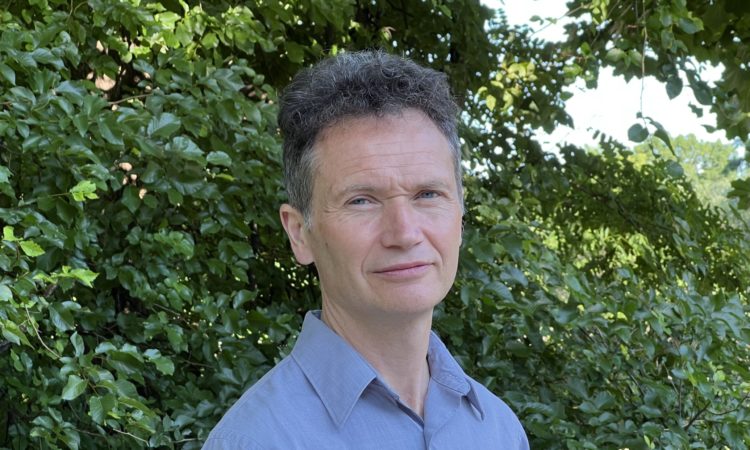
Talk with Gregor Jotzu, Tenure Track Assistant Professor at EPFL
What has been your main research activity and key results in recent years ?
Ever since finding out that even a single proton must be described as a quantum many-body system, I have been curious to understand how order emerges out of complexity. Initially I worked on entangled photons and ultracold atoms in optical lattices – very clean and controllable systems. But in recent years I have moved to the comparatively messy world of materials, which is rewardingly rich and full of surprises. And I have focussed on dynamics. Looking at the time-evolution of a system is a great tool for understanding how a certain order can even form in the first place. And it is also a powerful way to generate new states of matter.
In particular, by driving materials with intense mid-infrared or terahertz light, their properties can be altered fundamentally. One highlight was creating a Hall effect in graphene by illuminating it with circularly polarized light. Another very exciting observation was the expulsion of magnetic flux when driving an optical phonon in a cuprate. Normally, such an effect occurs at cryogenic temperatures, when cooling across a superconducting phase transition, as first observed by Meissner and Ochsenfeld. But when driving the material with a laser pulse, this even happens at room temperature. The effect only lasts for about two picoseconds, so it was necessary to develop a new method to perform ultrafast magnetometry.
What aspects of your research do you find most stimulating today?
I have moved to EPFL recently and had the chance to set up a new laboratory from scratch. So my team and I tried to combine all the best approaches I have had the chance to learn about in laboratories around the world – we are quite happy with the result. The methods for producing strong (multi-)terahertz pulses are very rich and constantly evolving, and it was exciting to try out new ideas and see them work well (or understand why they fail). At the same time, probing driven materials are quite distinct from other characterization methods and implementing and extending them at EPFL was also a lot of fun.
Very recently, most of the building activity has been completed and now we are starting to get results from several projects: Generating phonon-mediated artificial gauge fields, coherently controlling quantum spins with terahertz pulses, and exploring the dynamics of flux quantisation in superconductors. Some of our early measurements are quite surprising and this is one of my favourite things about doing research: Seeing results that do not make sense initially, and eventually reaching the point where it all comes together.
What are the next major directions you would like to explore in your work?
The understanding of periodically driven systems is progressing rapidly. For example, using multi-frequency driving, the spatial symmetries of a material can be fundamentally altered. Even more excitingly, I would like to go beyond looking at systems which are periodic in time and explore a broader class of “time-amorphous” order or symmetries that only exist when considering a combination of time and spatial dimensions. Beyond contributing to theoretical progress in this direction, I would love to implement such systems in my lab. The new functionalities that emerge are really fascinating.
At the same time, these “dynamic quantum materials” are also very complicated, so probing them in very way possible is crucial. So very much look forward to collaborating with colleagues in order to implement a true multi-messenger approach that combines optical, electron-based and x-ray probes.
What inspires you in your daily life?
The world is full of beauty, and in in particular in Lausanne every day I am overwhelmed by the splendour of the Lac Leman. It is a great privilege to experience this, and I believe that scientists have a particular responsibility to contribute to preserving and sharing the beauty of creation. Intellectually, I am very interested in the history, philosophy and sociology of science – understanding learning more about the very human process of how ideas form, spread and become accepted. But there is also so much more, the music of Beethoven or Leonard Cohen, the paintings of Vermeer or Bellini, the writing of Dostoevsky or Kurt Vonnegut. It is difficult not to be constantly inspired, because sometimes you also have to finish writing a boring report.